How Pregnancy Rewires The Brain — And Shapes The Baby’s Brain Too


How Pregnancy Rewires The Brain — And Shapes The Baby’s Brain Too
 By Inventive Minds Kidz Academy
 Added Fri, Jun 05 2026
By Inventive Minds Kidz Academy
Added Fri, Jun 05 2026
By Inventive Minds Kidz Academy
Added Fri, Jun 05 2026
Hey, Thanks For Subscribing!
Please check for a confirmation message and ensure you add us to a safe email list.
If you don't see a message in the next five minutes, check your spam or junk folders and mark our emails safe for next time.
See you soon!
Duplicate Email Found!
Well this is embarrassing... It looks like is already registered.
We have just sent an email to that address with a link to manage the subscription with us. If you don't see a message in the next five minutes, check the spam or junk folders, it's definitely there.
See you soon!

Introduction
Pregnancy changes your body. That much is obvious. But inside your skull, something just as remarkable is happening.
Forget the old jokes about "pregnancy brain" – the fog, the forgetfulness, the haze. Scientists have now watched this transformation in real time. The picture is not one of decline. It is one of specialization.
You are not falling apart. You are preparing for one of the most complex jobs you will ever take on: understanding and caring for a new human who cannot yet speak.

What Changes During Pregnancy
Let us start with a finding that sounds alarming but is actually good news.
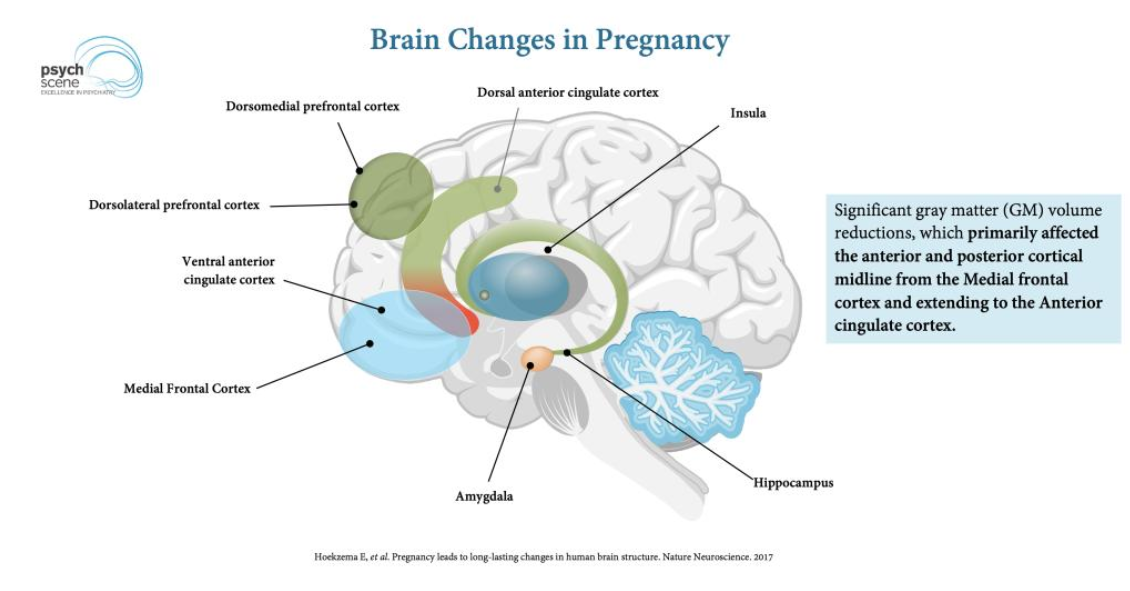
During pregnancy, gray matter volume decreases in certain areas. These are especially involved in social cognition – the ability to imagine what someone else is thinking or feeling.
Do not worry. This is not a bad thing.
It is similar to pruning a garden or what happens during adolescence. Your mind is eliminating unnecessary connections. It is becoming more efficient and specialized for motherhood. The regions that shrink are the same ones that become active when mothers look at pictures of their own babies. In other words, you are quietly getting ready for a relationship that does not yet exist.
At the same time, white matter – the information highways that connect different regions – becomes stronger and faster during the second trimester. This helps different parts of your thinking work together more quickly. Some of these changes are permanent. Others are temporary. All of them are adaptive.
What drives this remodeling? A flood of hormones – estrogen, progesterone, and later oxytocin (sometimes called the "love hormone"). These chemicals do not just affect your body. They enter your neural circuits and reshape the systems that control motivation, reward, and attachment.
After Birth: Experience Takes Over
Once the baby arrives, this rewiring does not stop. But now the main driver is no longer hormones. It is experience.
Every time you respond to a cry, you strengthen specific pathways. Every time you gaze into your baby’s face, you build new connections. This is how learning works. Repetition changes structure.
One of the most important changes happens in your reward system. When you see your baby smile or hear their voice, the same circuits that light up when people eat chocolate or fall in love become active. This is biology’s way of making caregiving feel good. You are not forcing yourself to love this work. Your brain is learning to find it rewarding.
Over time, your responses become faster and more automatic. You learn to read your baby’s cues without thinking. What feels overwhelming in the first weeks becomes more instinctive by month three or four. This is why parents often say "it gets easier." It is not just practice. It is your nervous system reorganizing itself around the new role.
This kind of learning continues for months and even years. The more you interact, the more efficient these circuits become.
How Your State Shapes Your Baby
Now here is where the story deepens.
Your own mental state does not stay inside your body. Through the placenta, your hormones – especially the stress hormone cortisol – reach your developing baby.

The fetal nervous system is especially sensitive to cortisol. The amygdala, a small region that processes emotion and detects threat, is rich in cortisol receptors. When you experience chronic, intense stress over many weeks, higher cortisol levels can reach the baby and influence development.
One study measured cortisol in mothers’ hair (which reflects stress over several months) and then scanned their newborns. Higher cortisol was linked to differences in the baby’s amygdala structure and connections. Interestingly, the effects were different in boys and girls. Male and female fetuses do not respond identically to the same environment.
But here is the most important part: these effects are not permanent.
A supportive environment after birth – sensitive caregiving, warmth, and strong social support – can significantly buffer and even reverse many of these influences. You are not sealing your child’s fate during pregnancy. You are opening a conversation that continues long after birth.
Everyday Things You Can Do
You do not need special classes or expensive tools. Some of the most powerful activities are already part of daily life. And the beautiful thing is that they support your own rewiring while also helping your baby.
Talk to Your Bump
Around the third trimester, your baby can hear your voice and will recognize it after birth. In one study, newborns whose mothers read a specific passage out loud every day later preferred that passage over a new one. They had learned it before birth.
Talking to your bump also engages your own social circuits. It is practice for the real thing.
Gently Touch Your Belly
When mothers stroke their abdomen, ultrasound shows that fetuses increase arm, head, and mouth movements – a clear response. Touch also releases oxytocin in you, lowering stress and increasing calm.
A gentle rub on the belly is a quiet conversation between two nervous systems.
Play Music You Enjoy
Babies can form memories of music heard before birth. Newborns whose mothers listened to a specific melody during pregnancy show different neural responses to that melody – even months later. Music also reduces anxiety and lifts your mood. Choose music that makes you feel good. Your baby will benefit from your calm.
Move Your Body
Walking, swimming, or moderate exercise during pregnancy is good for your baby’s development – and good for yours. Physical activity improves sleep, lowers stress, and increases a protein called BDNF that supports the health of your neurons. A daily walk is care for two at once.
Protect Your Sleep
Poor sleep is common in late pregnancy – up to 70 percent of women report trouble sleeping. Poor sleep has been linked to differences in the baby’s white matter and, in turn, to more fussiness in early infancy.
Prioritizing sleep – limiting screens before bed, resting when you can – is not selfish. It is one of the most effective things you can do.
Manage Stress
You cannot remove all stress, nor should you try. Mild, everyday stress is normal. But chronic, overwhelming stress is different.
Simple things – a phone call with a friend, a few minutes of deep breathing, asking for help – can lower cortisol levels and protect both of you. Social support is one of the most powerful stress regulators. You do not have to do this alone.
Why This Matters
The same flexibility that enables bonding also creates vulnerability. The postpartum period is the highest risk time in a woman’s life for depression and anxiety. This is not a personal failing. It is a predictable consequence of massive hormonal shifts, sleep deprivation, and ongoing rewiring.
But vulnerability is not destiny. Early support – whether through therapy, peer support, or simply acknowledging that this is a biological transition – can make a profound difference.
Many of the activities above are not just for your baby. They are forms of self‑care that support your own health during a time of rapid change.
Authored by:
Rose Morsh
BA Child Development,
RECE, Family Professional,
Mediator, Arbitrator
Final Thoughts
You are not losing yourself during pregnancy. You are adapting to a new role.
Motherhood is not just a life transition. It is a neurological transition. Like any period of major change – adolescence, learning a new skill, recovering from illness – this transition deserves understanding, patience, and support.
The same activities that help you feel calmer and more connected also help your baby grow stronger. You are not just growing a baby. You are growing a mother. And that is worth celebrating.
Introduction
Pregnancy changes your body. That much is obvious. But inside your skull, something just as remarkable is happening.
Forget the old jokes about "pregnancy brain" – the fog, the forgetfulness, the haze. Scientists have now watched this transformation in real time. The picture is not one of decline. It is one of specialization.
You are not falling apart. You are preparing for one of the most complex jobs you will ever take on: understanding and caring for a new human who cannot yet speak.
What Changes During Pregnancy
Let us start with a finding that sounds alarming but is actually good news.
During pregnancy, gray matter volume decreases in certain areas. These are especially involved in social cognition – the ability to imagine what someone else is thinking or feeling.
Do not worry. This is not a bad thing.
It is similar to pruning a garden or what happens during adolescence. Your mind is eliminating unnecessary connections. It is becoming more efficient and specialized for motherhood. The regions that shrink are the same ones that become active when mothers look at pictures of their own babies. In other words, you are quietly getting ready for a relationship that does not yet exist.
At the same time, white matter – the information highways that connect different regions – becomes stronger and faster during the second trimester. This helps different parts of your thinking work together more quickly. Some of these changes are permanent. Others are temporary. All of them are adaptive.
What drives this remodeling? A flood of hormones – estrogen, progesterone, and later oxytocin (sometimes called the "love hormone"). These chemicals do not just affect your body. They enter your neural circuits and reshape the systems that control motivation, reward, and attachment.
After Birth: Experience Takes Over
Once the baby arrives, this rewiring does not stop. But now the main driver is no longer hormones. It is experience.
Every time you respond to a cry, you strengthen specific pathways. Every time you gaze into your baby’s face, you build new connections. This is how learning works. Repetition changes structure.
One of the most important changes happens in your reward system. When you see your baby smile or hear their voice, the same circuits that light up when people eat chocolate or fall in love become active. This is biology’s way of making caregiving feel good. You are not forcing yourself to love this work. Your brain is learning to find it rewarding.
Over time, your responses become faster and more automatic. You learn to read your baby’s cues without thinking. What feels overwhelming in the first weeks becomes more instinctive by month three or four. This is why parents often say "it gets easier." It is not just practice. It is your nervous system reorganizing itself around the new role.
This kind of learning continues for months and even years. The more you interact, the more efficient these circuits become.
How Your State Shapes Your Baby
Now here is where the story deepens.
Your own mental state does not stay inside your body. Through the placenta, your hormones – especially the stress hormone cortisol – reach your developing baby.
The fetal nervous system is especially sensitive to cortisol. The amygdala, a small region that processes emotion and detects threat, is rich in cortisol receptors. When you experience chronic, intense stress over many weeks, higher cortisol levels can reach the baby and influence development.
One study measured cortisol in mothers’ hair (which reflects stress over several months) and then scanned their newborns. Higher cortisol was linked to differences in the baby’s amygdala structure and connections. Interestingly, the effects were different in boys and girls. Male and female fetuses do not respond identically to the same environment.
But here is the most important part: these effects are not permanent.
A supportive environment after birth – sensitive caregiving, warmth, and strong social support – can significantly buffer and even reverse many of these influences. You are not sealing your child’s fate during pregnancy. You are opening a conversation that continues long after birth.
Everyday Things You Can Do
You do not need special classes or expensive tools. Some of the most powerful activities are already part of daily life. And the beautiful thing is that they support your own rewiring while also helping your baby.
Talk to Your Bump
Around the third trimester, your baby can hear your voice and will recognize it after birth. In one study, newborns whose mothers read a specific passage out loud every day later preferred that passage over a new one. They had learned it before birth.
Talking to your bump also engages your own social circuits. It is practice for the real thing.
Gently Touch Your Belly
When mothers stroke their abdomen, ultrasound shows that fetuses increase arm, head, and mouth movements – a clear response. Touch also releases oxytocin in you, lowering stress and increasing calm.
A gentle rub on the belly is a quiet conversation between two nervous systems.
Play Music You Enjoy
Babies can form memories of music heard before birth. Newborns whose mothers listened to a specific melody during pregnancy show different neural responses to that melody – even months later. Music also reduces anxiety and lifts your mood. Choose music that makes you feel good. Your baby will benefit from your calm.
Move Your Body
Walking, swimming, or moderate exercise during pregnancy is good for your baby’s development – and good for yours. Physical activity improves sleep, lowers stress, and increases a protein called BDNF that supports the health of your neurons. A daily walk is care for two at once.
Protect Your Sleep
Poor sleep is common in late pregnancy – up to 70 percent of women report trouble sleeping. Poor sleep has been linked to differences in the baby’s white matter and, in turn, to more fussiness in early infancy.
Prioritizing sleep – limiting screens before bed, resting when you can – is not selfish. It is one of the most effective things you can do.
Manage Stress
You cannot remove all stress, nor should you try. Mild, everyday stress is normal. But chronic, overwhelming stress is different.
Simple things – a phone call with a friend, a few minutes of deep breathing, asking for help – can lower cortisol levels and protect both of you. Social support is one of the most powerful stress regulators. You do not have to do this alone.
Why This Matters
The same flexibility that enables bonding also creates vulnerability. The postpartum period is the highest risk time in a woman’s life for depression and anxiety. This is not a personal failing. It is a predictable consequence of massive hormonal shifts, sleep deprivation, and ongoing rewiring.
But vulnerability is not destiny. Early support – whether through therapy, peer support, or simply acknowledging that this is a biological transition – can make a profound difference.
Many of the activities above are not just for your baby. They are forms of self‑care that support your own health during a time of rapid change.
Authored by:
Rose Morsh
BA Child Development,
RECE, Family Professional,
Mediator, Arbitrator
Final Thoughts
You are not losing yourself during pregnancy. You are adapting to a new role.
Motherhood is not just a life transition. It is a neurological transition. Like any period of major change – adolescence, learning a new skill, recovering from illness – this transition deserves understanding, patience, and support.
The same activities that help you feel calmer and more connected also help your baby grow stronger. You are not just growing a baby. You are growing a mother. And that is worth celebrating.
Most Talked About Posts

You May Also Like
Staff Picks

Halloween 2020: How to make it a special day for our children

How to Create a Balanced Lifestyle that will Support your Adolescent’s Mental Health

Managing Parenting Conflicts

Now Trending




Our Newsletter
Duplicate Email Found!
Well this is embarrassing... It looks like is already registered.
We have just sent an email to that address with a link to manage the subscription with us. If you don't see a message in the next five minutes, check the spam or junk folders, it's definitely there.
See you soon!

Join Our Newsletter
Hey, Thanks For Subscribing!
Please check for a confirmation message and ensure you add us to a safe email list.
If you don't see a message in the next five minutes, check your spam or junk folders and mark our emails safe for next time.
See you soon!
Duplicate Email Found!
Well this is embarrassing... It looks like is already registered.
We have just sent an email to that address with a link to manage the subscription with us. If you don't see a message in the next five minutes, check the spam or junk folders, it's definitely there.
See you soon!